THE ARMY APPROVED ITS FIRST NEW LETHAL HAND GRENADE SINCE 1968. HERE’S WHY THE M111 EXISTS
COMMENT
SHARE

ADVERTISEMENT
Close your eyes and picture an Army grenade. What comes to mind is most likely a green, hand held device with a hard shell exterior. Pull the pin, a few moments later… BOOM! That’s because since Vietnam, the military has used the same designs for grenades. Until March 10, 2026, when the Army announced it had cleared the M111 Offensive Hand Grenade for Full Material Release, the approval step that allows the weapon to move into fielding after testing and validation. According to the Army, the M111 is the first new lethal hand grenade to achieve Full Material Release since 1968, when the Mk3A2 entered service.
The Army says the M111 was developed by the Capabilities Program Executive Office Ammunition and Energetics in conjunction with the U.S. Army Combat Capabilities Development Command Armaments Center at Picatinny Arsenal. The Army also says the new grenade will replace the obsolete body and fuse of the Mk3A2 hand grenade series.
Why the Army Says It Needed a New Grenade
The mission purpose for the M111 is tied to combat in enclosed and restricted terrain. In its official release, the Army says the M111 is designed to help Soldiers fight more effectively in closed-quarter urban environments by using blast overpressure rather than fragmentation to deliver lethality.
The Army says the M67 fragmentation hand grenade projects lethal and incapacitating fragments that can be deflected in enclosed terrain such as buildings, rooms, and structures. The M111 projects high blast-overpressure effects that are less affected by obstacles in enclosed and restricted spaces.
Army officials tied that need directly to combat lessons from Iraq. In the Army release, Col. Vince Morris, project manager for Close Combat Systems, said one lesson from “door-to-door urban fighting in Iraq” was that the M67 “wasn’t always the right tool for the job” because the “risk of fratricide on the other side of the wall was too high.”
Which Military Branch Is Right for You?
Answer 10 questions to discover which branch of the U.S. Armed Forces best matches your personality, interests, and goals.
10 questions • Takes about 2 minutes

Nobody Prepared You for Military Life
But we can help. Join over 100k spouses already getting the advice, resources, and military tea they need to thrive.
What Makes the M111 Different
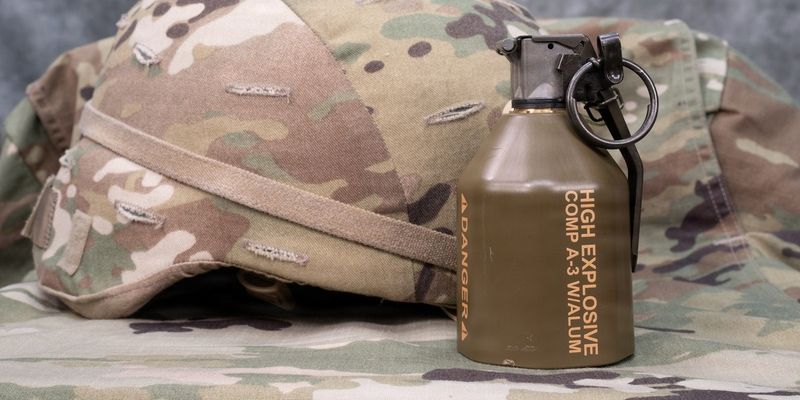
The M111 is intended to replace the Mk3A2 series, which it says is restricted for use because of the asbestos contained in the body of that model. The M111 uses a plastic body instead that’s fully consumed during detonation, according to the Army.
It is just as important to note that the Army is not presenting the M111 as a full replacement for the M67. The service says Soldiers will use the M67 in open terrain to maximize fragment effects, while using the M111 in enclosed and restricted terrain to maximize blast-overpressure effects.
Training Compatibility Is Part of the Story Too
The Army says the M111 and its training version, the M112, use the same five-step arming process as the M67 and its training version, the M69. The service says that commonality is meant to let Soldiers “train as they fight.”
The Army also says the M111 and M112 use the same fuses as the M67 and M69, respectively. According to Army officials, that commonality can reduce costs by leveraging shared production lines, and both grenades have government-owned intellectual property that allows production contracts to be competed across the industrial base.
Why This Matters Now
Since the new model of grenade is designed for enclosed, restricted, and urban environments, where fragmentation is supposed to be avoided, the M111 is less of a replacement for every grenade in the inventory and more a new option for a specific kind of fight. New additions like the M111 ensure our Soldiers are equipped with the best ammunition available.
ADVERTISEMENT
FAQs
What is the M111?
The M111 Offensive Hand Grenade, which the Army says has been cleared for Full Material Release.
Why is it significant?
The Army says it is the first new lethal hand grenade to achieve Full Material Release since 1968.
ADVERTISEMENT
What does it replace?
The Army says it will replace the obsolete body and fuse of the Mk3A2 hand grenade series.
Why was the Mk3A2 restricted?
The Army says the Mk3A2 is restricted for use because of its asbestos body.
How is it different from the M67?
The Army says the M67 is used to maximize fragment effects in open terrain, while the M111 is meant to maximize blast-overpressure effects in enclosed and restricted terrain.
ADVERTISEMENT
Is there a training version?
Yes. The Army says the M111’s training counterpart is the M112.
Suggested reads:
Join the Conversation

BY NATALIE OLIVERIO
Veteran & Senior Contributor, Military News at MilSpouses
Natalie Oliverio is a Navy Veteran, journalist, and entrepreneur whose reporting brings clarity, compassion, and credibility to stories that matter most to military families. With more than 100 published articles, she has become a trusted v...
- Navy Veteran
- 100+ published articles
- Veterati Mentor
ADVERTISEMENT




ADVERTISEMENT
