You’re Packing, They’re Grieving: What Military Teens Wish Their Parents Knew About Moving

ADVERTISEMENT
Halfway into ninth grade, most teenagers have figured out where they fit in the high school hierarchy. For military teens, that rarely holds. Between kindergarten and high school graduation, the average military-connected child changes schools six to nine times. That is roughly three times more often than their civilian peers. Each move resets the clock. Teens experience new hallways, new teachers, a new social hierarchy, and answering the question every military teen learns to dread: "So, where are you from?"
Parents living through a Permanent Change of Station (PCS) tend to measure the move in logistics: household goods weight allowances, school enrollment paperwork, and the scramble to find a pediatrician before records transfer. Teenagers measure it differently. They measure it in what and who gets left behind.
"Adults plan the move. Kids live the loss," is how one Army teen's school counselor summarized it.
That gap between how parents and teenagers experience the same relocation is where a lot of quiet suffering happens, and where military mental health advocates say families most need a bridge.
The Move Parents See vs. the Move Teens Feel
For a parent, a PCS is a project with a beginning and an end. Orders arrive, household goods get packed, the family arrives at the next duty station, and life resumes. For a teenager, the same event unfolds on a completely different timeline.
This frequent relocation creates a pattern researchers call "chronic transition.” Rather than facing a singular difficult year, military teens face a recurring cycle of upheaval that can hit right as adolescent identity, independence, and social belonging are supposed to be taking shape.
A move at age seven means a new backpack and a new bus route. A move at age 15 means walking into a school where the friend groups, the unwritten social rules, and the dating landscape have already been decided.


Nobody Prepared You for Military Life
But we can help. Join over 100k spouses already getting the advice, resources, and military tea they need to thrive.
Frequent Relocation Can Lead to Identity Interruption
Military teens change schools 6 to 9 times before graduation
A military-connected teenager changes schools six to nine times before graduation. Most of those moves land them in a civilian school where almost nobody else has done it once.
Adolescence is the period when a person is supposed to figure out who they are, separate from their parents, anchored instead in friend groups, interests, and a sense of "my people" and "my place." Frequent relocation disrupts exactly that process.
Teens who've grown up moving often describe a strange split: they get very good at the surface-level skills of fitting in fast while never quite letting themselves get attached. It's a defense mechanism as much as a social skill. If you know you might move again in two years, why invest fully in people you'll have to leave?
“I try not to think about it,” said one 13-year-old who has been to five different schools since first grade.
“I just say goodbye. It depends on the person, but I usually try to stay in touch.”
That mindset can leave older military teens describing their own identity in oddly detached terms, as something built around adaptability rather than roots.
"Home" stops meaning a place and starts meaning whichever base or house the family currently occupies, or sometimes nothing geographic at all. Some teens cope by anchoring their identity in something portable, such as a sport, an instrument, an online community, or a sibling relationship, because it survives the move.
For some, that detachment doesn't resolve when childhood ends; it becomes part of how they define themselves as adults. Bradley Taisipic, an Army Veteran who grew up moving frequently as a military child himself, made a deliberate choice about his own kids because of it.
"I know firsthand what it's like to move around all the time as a kid, and I didn't want that for my children," said Taisipic.
"I don't have any lifelong friends or a true hometown. I wish my dad knew the impact his military career had on us, but I don't blame him for it."
Mental health professionals who work with military families note that this isn't automatically unhealthy. Many military teens develop genuine strengths from the lifestyle: adaptability, confidence in unfamiliar situations, and an ease in meeting new people that civilian peers often lack. The risk isn't mobility itself. It's mobility without enough emotional processing in between moves, layered on top of an age when identity is already unstable.
What Teens Say They Wish Parents Understood
Interviews and survey data collected by military family organizations point to a consistent set of things teenagers wish their parents grasped about the emotional side of PCS season. Below are some ways in which teens have voiced that they wish their parents understood more about their feelings around moving.
- Parents sometimes minimize a teen's sadness over leaving a friend of one or two years, comparing it to their own decades-long friendships. To a teenager who has moved frequently, that friendship may be the longest relationship of their adolescence outside their family.
- Teens can be genuinely excited about a new duty station's proximity to the ocean, a bigger school, or reuniting with a childhood friend, and may still be sad about leaving.
- Making friends as a child on a playground is a different skill than breaking into an established friend group as a high school student. Older military teens often say the social stakes get higher with every move, because the social structures they're entering have had years to solidify.
- Military culture often prizes resilience, and teens absorb that expectation early. Sometimes performing okay-ness for a parent who is already stretched thin by the move itself, a deployment, or a new job. Feeling required to be fine can make it harder to admit when they're not.
- Reassurance ("you'll make friends, you always do") can land as dismissive. Teens consistently say that what helps more is a specific, open-ended check-in rather than a prediction that everything will be okay.

Where Therapy With Talkspace Fits In
School counselors and installation-based support programs remain a first line of help for many military teens, but they're often stretched across large caseloads and, depending on the base, may see a student for only a few months before the next PCS disrupts that relationship too. That's part of why more military families are turning to individual therapy.
For a military teenager, that continuity is the whole point. A therapist a teen can keep seeing by video call after a relocation offers something a new school counselor at a new base cannot: a relationship that survives the move. Talkspace's virtual therapy model, which connects teens with licensed therapists by video, phone, or messaging, is built around exactly that kind of continuity.
Therapy can also give military teens language for what they're navigating, such as how to grieve a friendship, how to build new relationships, and how to separate their sense of self from their zip code. For teens who've internalized the idea that struggling with a move is a sign of weakness, having a therapist who treats that struggle as normal can be its own form of relief.
Military parents navigating a PCS with a teenager in the house face a genuine bind. The move is happening regardless, the timeline is set by orders rather than family preference, and there's often no good alternative to relocating together. Teens aren't asking to unpack the moving truck; they're just asking for a different conversation along the way. That includes being looped into the move earlier rather than told after the decision is final, being allowed to grieve the old duty station without being rushed toward gratitude for the new one, and having an outlet, whether that's a parent, a counselor, or a licensed therapist, that doesn't disappear the moment the next set of orders arrives.
Between school liaisons, peer-support programs, and telehealth options that follow a family from one duty station to the next, military teens can use Talkspace as a means of consistent support to navigate the uncertainty of PCS season.
This article is a result of a collaboration with Talkspace.
Plan your PCS
Turn your move into a plan you can actually follow
Answer a few quick questions and get a personalized timeline, a prefilled budget estimate, and a step-by-step checklist built around your family and your new base.
Continue Reading

PCS Parenting Guide: Supporting Military Kids During Moves
PCS Advice

Military Spouses Share the PCS Tips and Tricks They Wish They'd Known Sooner
PCS Advice
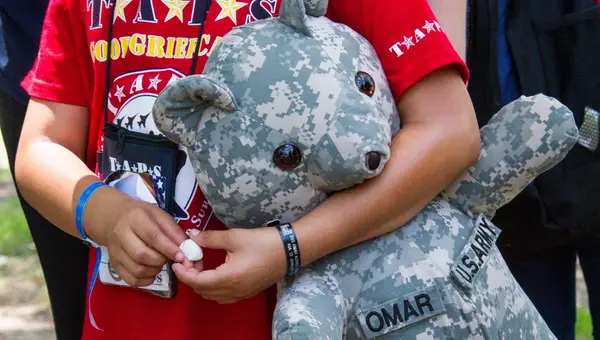
What Surviving Military Children Wish Adults Understood About Grief
Childcare
Join the Conversation

BY TRACY FUGA
Military Spouse & Military Lifestyle Writer at MilSpouses
BY TRACY FUGA
Military Spouse & Military Lifestyle Writer at MilSpouses
Tracy Fuga is a San Diego-based writer, editor, and marketing professional with nearly two decades of experience in content creation and communications. A former editor at MARCOA Media — the original publisher of MyBaseGuide — she has a l...
ADVERTISEMENT

ADVERTISEMENT