Lawmakers Aim to Simplify Airport Travel for Military Families With Dedicated TSA Lanes

ADVERTISEMENT
Airport security isn’t exactly anyone’s favorite part of traveling. There’s going to be long lines, passengers rushing, and the chaotic scramble to unpack electronics or remove shoes is familiar to almost everyone who flies. Military families also experience this, but with added pressure. But a newly introduced House bill aims to make that experience a little easier for them.
The legislation would allow the Transportation Security Administration (TSA) to establish three-year dedicated security lanes for active-duty service members and their families at airports, testing whether priority screening can be expanded more consistently at selected airports.
Here’s what we know about the bill's changes to TSA airport security family lanes.
Airport Security Can Be Stressful for Military Families
Traveling for military families is often part of their regular lives, as active-duty service members often travel due to Permanent Change of Station (PCS) moves. In that situation, their spouses and children have to make those trips alongside them. They are pretty much familiar with how the airport works.
Military travel, especially a PCS move, often leaves families with limited scheduling flexibility. Reporting dates are set by military orders, and flights are often booked through official travel channels, which can create more than just a scheduling headache. Not only that, but traveling across the country with multiple suitcases, important documents, young children, and sometimes pets makes it harder.
With all of these factors, airport security can feel like another hurdle in an already packed travel day. These experiences happen repeatedly throughout a career. While each security screening may only add a few extra minutes, those delays can become another recurring source of stress over the years.
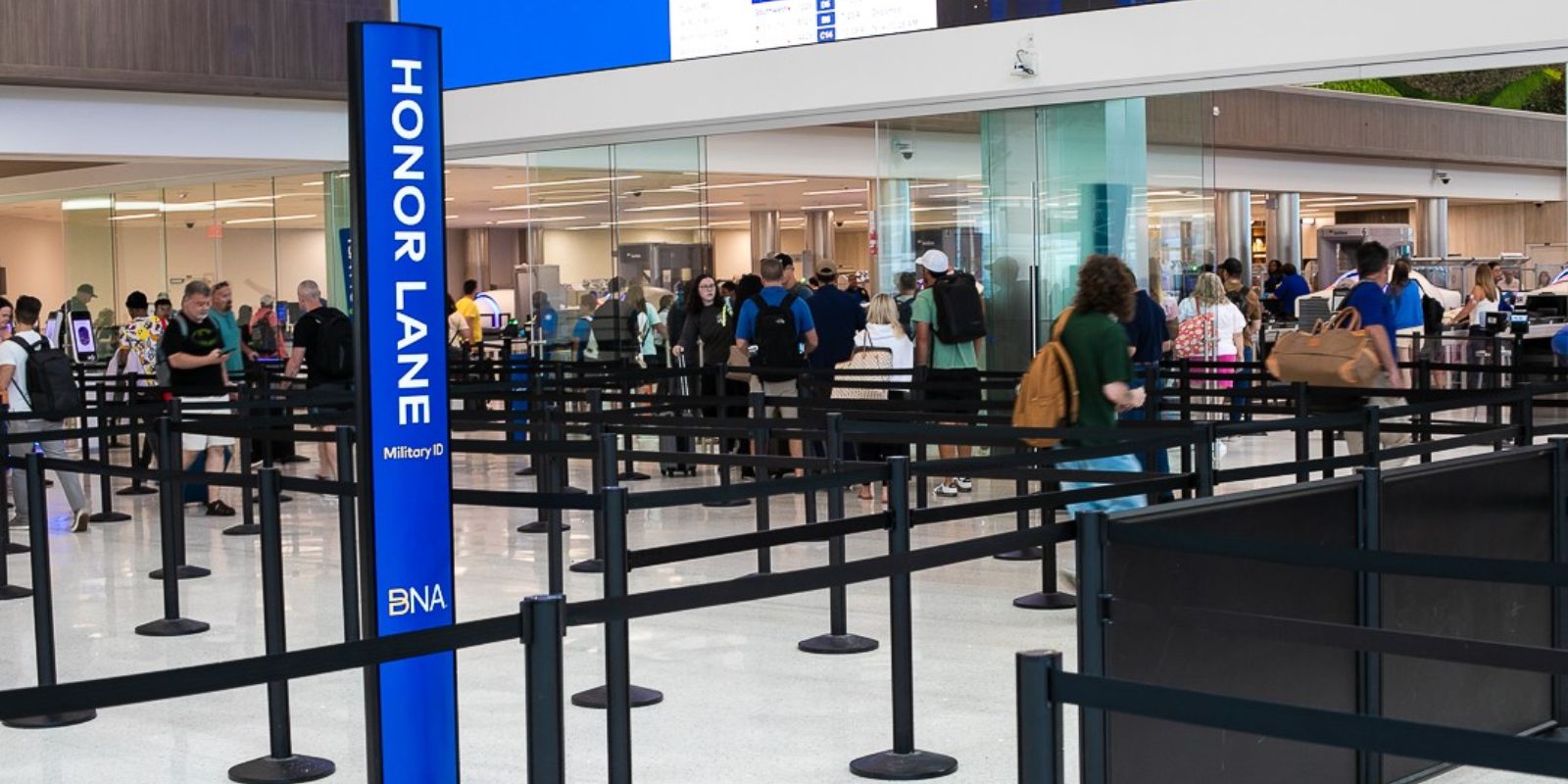
It’s true that some airports already offer military lanes or front-of-the-line service, but availability varies by airport. The proposed legislation doesn't eliminate the challenges of military travel. There will be travel challenges, and moving across the country will never be completely stress-free.
Milspouses · Airport Directory
Airports With Military Fast-Lane Access
Albany International Airport
Albany, New York
However, the legislation aims to remove a recurring obstacle military families encounter every time they fly.
The scale of military travel helps put the proposal into perspective. Millions of service members and their families rely on air travel for PCS moves, deployments, training, and other official assignments. So a small change like this can make the experience for military families meaningful to a large community.
Milspouses · By the Numbers
Military Travel by the Numbers
1.33 million
Active-duty service members in the U.S.
1.2 million
Children in active-duty military families
30+
Airports that currently offer dedicated military lanes or front-of-the-line service
2–4 years
Average time between PCS moves
400,000–600,000
Military families completing a PCS move each year

Nobody Prepared You for Military Life
But we can help. Join over 100k spouses already getting the advice, resources, and military tea they need to thrive.
What Would the Proposed Bill Change?
The new bill, H.R. 9328, “Improving Travel for Military Members Act,” would authorize the TSA to implement a pilot program. This is to expedite access to airport security screening for active-duty military personnel traveling with their family members.
It was introduced in the House on June 18, 2026, by Rep. Sheri Biggs (R-S.C.), with Rep. Daniel Goldman (D-N.Y.) as the original bipartisan cosponsor. Later, Rep. Eugene Vindman (D-Va.) joined as an additional cosponsor.
Rep. Biggs brings a personal perspective to the legislation as a lieutenant colonel in the Air National Guard. When asked about the reasoning behind the legislation, she explained,
"Our service members and their families already sacrifice through deployments, long separations, and constant moves. Making travel easier is one practical way we can honor their service and show them the respect they more than deserve.”
In a statement, she noted that her legislation aims to strengthen and standardize existing TSA efforts,
"Depending on the airport, military members and their families may not receive expedited screening through dedicated lines, preferred lanes or front-of-line access," she said.
"My legislation builds on this important effort. Service members will benefit from faster, more efficient travel while maintaining the same high security standards."
The legislation would allow the Transportation Security Administration to test the program at selected airports before considering broader implementation. If the TSA establishes the pilot, it would prioritize airports located near military installations with large active-duty populations.
The bill moved quickly through the House after its introduction. On June 24, 2026, the House Homeland Security Committee unanimously voted 30-0 to advance the legislation.
The House later passed the bill by voice vote on July 13, 2026, before sending it to the Senate the following day. It is currently under review by the Senate Committee on Commerce, Science, and Transportation.
If enacted, the pilot program would help the Transportation Security Administration (TSA) evaluate whether dedicated military screening lanes improve the travel experience before deciding whether to expand the initiative to more airports nationwide.
Ultimately, the goal is to improve the travel experience for military personnel and their families who are most likely to fly for deployments, training, or permanent change-of-station moves.

How Does TSA Improve Experience for Military Families
The TSA was asked whether H.R. 9328 would change or expand these existing services.
While the agency declined to comment on pending legislation, it provided the following statement through a spokesperson:
"TSA honors our nation's heroes by providing special security screening privileges to service members, veterans, and their families. Our military community enjoys access to dedicated military lanes or front-of-the-line service at over 30 airports, dedicated assistance through TSA Cares, and discounted TSA PreCheck for military spouses. TSA PreCheck is available at no cost to uniformed service members, eligible military survivor family members, and qualifying disabled veterans.”
Active-duty service members and their families already have access to several TSA benefits even though H.R. 9328 would introduce a pilot program for dedicated military security lanes. However, those benefits are not always available at every airport. So it’s important to know what services you should be offered.
The caveat here is that participation depends on the airport. Meaning, each family can have a different experience from one location to another. Here are the airports that provide military lanes:
TSA PreCheck for Uniformed Service Members
In addition to priority screening at select airports, active-duty service members receive complimentary TSA PreCheck by using their Department of Defense ID number as their Known Traveler Number when booking flights.
TSA’s website states, “TSA PreCheck is a program that allows low-risk travelers to enjoy a secure and efficient security screening experience in dedicated TSA PreCheck lanes.”
Active-duty service members can keep their shoes, belts, and light jackets on. Plus, they are not required to remove laptops or 3-1-1 liquids from their carry-on bags.
TSA offers four services through the PreCheck program for active-duty service members, their spouses, and even veterans.
- Uniformed Service Members and DOD Civilians
- Receive a free TSA PreCheck expedited screening as a benefit of their employment and service
- Includes the following:
- Reserve components
- National Guard (both Army and Air)
- U.S. Coast Guard and U.S. Coast Guard Reserve
- Students of the U.S. military service academies (USMA, USNA, USAFA, USCGA, USMMA)
- United States Public Health Service (USPHS) Commissioned Corps
- NOAA Commissioned Officer Corps
- Federal civil service employees
- Non-appropriated fund (NAF) civilians
- Military Spouse
- Must meet TSA PreCheck eligibility requirements and have the required documentation for enrollment to have the $25 off.
- Must be a spouse of a currently serving military and uniformed service member.
- Must have an unexpired U.S. Department of Defense/Uniformed Services photo ID with the relationship listed as “Spouse.”
- Military Survivor Family
- Receive a free TSA PreCheck but must meet requirements and have the required documentation for enrollment.
- Must be a spouse, parent, child, or sibling of the fallen service member who died on active duty or died from a service-connected injury or illness after separation.
- Qualifying Disabled Veterans
- Free TSA PreCheck enrollment and renewal under the VETS Safe Travel Act,
- Limited to veterans enrolled in VA healthcare who have a service‑connected disability of permanent blindness or require the use of a VA‑issued wheelchair or prosthetic limb.
ADVERTISEMENT
TSA Cares Assistance for the Military
TSA also operates TSA Cares, a program that assists travelers who may need additional support during the screening process, including military families traveling with injured service members or individuals with medical conditions and disabilities.
- Wounded Warriors: TSA coordinates with the appropriate military branch to verify eligibility and arrange assistance at security checkpoints for departing and arriving flights.
- Disabled Service Members and Veterans: Eligible travelers can request assistance through TSA, which shares their support needs with participating airports. Veterans who are not enrolled in TSA PreCheck will use standard security screening lanes.
The proposed pilot program would build on these existing benefits by testing whether dedicated military screening lanes can be offered more consistently at airports, particularly those located near military installations.

What Comes Next?
H.R. 9328 has already cleared one major step in the legislative process. After passing the House, the bill was received in the Senate and referred to the Senate Committee on Commerce, Science, and Transportation for consideration.
To better understand how military family organizations view the proposal, we reached out to several national organizations for additional perspectives.
The Military Family Advisory Network said it is not currently tracking the legislation and therefore was unable to provide a statement on the bill.
We also reached out to Blue Star Families, which likewise said it does not currently have data or research on the proposal.
While neither organization commented directly on the legislation, their responses highlight that there is currently limited research measuring how dedicated TSA airport security family lanes might affect military travelers.
The proposal has gained support and cleared the House; however, it would not automatically create dedicated military airport lanes nationwide. If the bill becomes law, TSA would be authorized to launch the pilot program. The pilot program could then provide valuable data on whether expedited screening improves travel efficiency and overall traveler experience for military families.
Because the bill prioritizes creating pilot airport lanes near military installations, those locations would likely be among the first to participate if the pilot program moves forward. TSA would also be responsible for developing the program's implementation details, including how eligible travelers would access expedited screening.
For now, we know the bill is already in the Senate Committee on Commerce, Science, and Transportation, where lawmakers will decide whether to advance it for a full Senate vote. Until then, active-duty service members and their families can continue to use the TSA benefits already available while the pilot programs remain under consideration.
Milspouses · Bill Tracker
H.R. 9328: Path Through Congress
Plan your PCS
Turn your move into a plan you can actually follow
Answer a few quick questions and get a personalized timeline, a prefilled budget estimate, and a step-by-step checklist built around your family and your new base.
Continue Reading
TSA Honor Lane: Fast-Track Security for Military Families
Spouse Benefits
TSA Expands Free PreCheck for Military Spouses, Gold Star Families
Military Spouse & Family

How the New Bipartisan Bill Protects PCS Leave for Military Spouses
PCS Advice
Join the Conversation

BY ALLISON KIRSCHBAUM
Veteran, Military History & Culture Writer at MilSpouses
Allison Kirschbaum is a Navy Veteran and an experienced historian. She has seven years of experience creating compelling digital content across diverse industries, including Military, Defense, History, SaaS, MarTech, FinTech, financial serv...
- Navy Veteran
- 7 years experience in digital content creation
- Expertise across Military, Defense, History, SaaS, MarTech, FinTech industries
ADVERTISEMENT


ADVERTISEMENT