FCC Providers vs Child Development Centers: Understanding the Differences
COMMENT
SHARE

ADVERTISEMENT
FCC.
CDC.
MCCYN.
SAC.
More acronyms. More deciphering codes.
If you’re new to the military, it’s yet another part of life that is instantly overwhelming. All you want is to figure out what childcare solution is best for your family at your new duty station.
For most families, it comes down to two options: Family Childcare (FCC) or a Child Development Center (CDC).
Even when you’ve narrowed it down, there are more questions.
I’ve already been down the FCC vs CDC rabbit hole, so you can avoid doing the same – let’s get straight to the information you need to make the best decision for your children.
Understanding the Differences Between FCCs and CDCs on Your Military Installation

Nobody Prepared You for Military Life
But we can help. Join over 100k spouses already getting the advice, resources, and military tea they need to thrive.
Family Childcare (FCC)
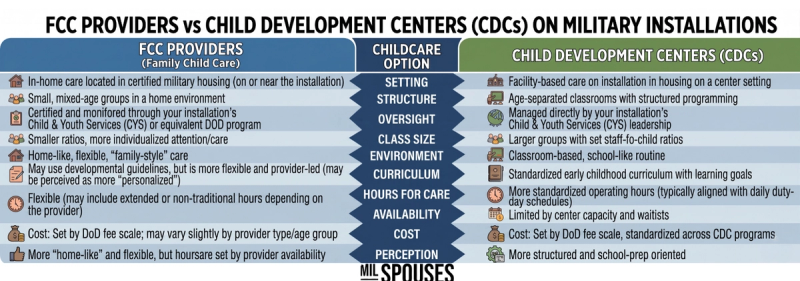
Family Childcare (FCC) is childcare provided in a certified provider’s home on your installation. It’s not at a center, not in a traditional classroom, but in the provider's home. FCC providers can care for children ages 4 weeks to 12 years.
FCCs are slightly more affordable than CDC care due to the DoD fee scale (though both are income-based and standardized across installations).
Though care is in the home, FCC providers are still part of the military child care system, which means they are:
- Held to military childcare standards
- Trained and certified through your installation’s programs
- Inspected regularly (just as a childcare center is)
- Background checked
There is sometimes a perception that FCC programs provide informal care, and in my experience, this is untrue – it depends on the provider and what atmosphere your child thrives in.
Attending childcare with an FCC provider usually means:
- One consistent teacher (though backup care and substitutes are sometimes offered)
- Smaller child-to-caregiver ratios
- Various ages with the provider (some providers prefer to have specific age ranges, while others may have a wider range of ages in their home)
FCC programs generally work best for military families who need:
- Care that is flexible or unpredictable
- Faster availability for childcare – CDC waitlists tend to be longer, especially for younger children
- Childcare before an infant is 6 weeks old, or childcare for siblings of various age ranges in the same space (up to 12 years old)
- Smaller, home-style care
Child Development Centers (CDC)
Child Development Centers (CDCs) are childcare centers located on a military installation. CDC care is more structured, with classroom-based options that are most similar to those in childcare centers throughout the country.
CDCs offer childcare for children ages 6 weeks to 5 years – once your child ages out and begins school, they can attend school-aged care (SAC), as needed.
Attending childcare in a CDC usually means:
- A “school-like” drop-off and pickup structure
- Age-based classrooms
- Larger teacher to student rations – potentially multiple caregivers in one classroom
- Structured classroom-like schedules and routines
CDC programs generally appeal to military families who need:
- A classroom environment
- Fixed operating hours with scheduled holidays, training days, and closures
- Stable, long-term care arrangements
How to Sign Up for Military Childcare
Once you understand the difference between FCC and CDC, the next step is to get on the waitlist – earlier is always better, especially during a PCS.
Here’s what the process generally looks like:
- Create a family account at MilitaryChildCare.com
- Follow the steps on the website above to add your child(ren) to any waitlists for the CDC or FCC – priority for care is the same for both.
- Ensure you have all physicals, vaccines, etc., completed so that when you meet with your Child and Youth Services office, you’ll have all necessary paperwork.
- If you choose to take the FCC route, you will be set up to interview with and meet providers who have openings.
- When care is available, it will be offered to you via email and the Military ChildCare portal, where you’ll have 2 business days to respond.
If you’re unsure about the process, your installation’s Child and Youth Services office can assist.
ADVERTISEMENT
Deciding Between the CDC or a FCC Provider Depends on Your Needs
When we joined the military with a two-year-old, we’d heard all the rumors you can think of about childcare through CDC and FCC providers.
Everyone had something to say – especially in the age of social media – it was hard not to feel like no matter what decision I made, it was going to be wrong.
But here’s the thing: you know your children, and you know your family.
Take the time you need to decide what’s best and follow your intuition. Although I had heard all sorts of stories (both good and bad), I’ve used both the CDC and an FCC provider, and both provided excellent care for my children.
One child thrived in the CDC environment, and one absolutely adores her FCC provider and learns more than I could ever teach her. The third? Who knows, maybe she’ll stay home with me forever.
In the end, the best decision is the one that supports your child and your reality.
Continue Reading

The First 30 Days of a PCS Are the Hardest: Why They Still Break Down at the Start
PCS Advice

The Career Cost of Military Life: Why Military Spouse Unemployment Still Isn’t Fixed
Career & Pay

Milspouses Qualify for More VA Benefits Than Many Realize: Here’s What You Might Be Missing
Health & Fitness
Join the Conversation

BY JESSICA GETTLE
Military Spouse & Family Life Writer at MilSpouses
BY JESSICA GETTLE
Military Spouse & Family Life Writer at MilSpouses
Jessica Gettle is a military spouse of more than a decade, part of the EOD community, and a communications professional with 10 years of experience. She combines her career expertise with a deep, personal understanding of the unique rhythms...
- Military Spouse
- SEO content writer
- Experience with deployments and relocations
ADVERTISEMENT



ADVERTISEMENT
